All posts by admin

Sanding details

Collated from newsgroup postings.

Sanding for me is still one of my biggest hurdles in producing quality work (quality at least in the sense it’s the best I am capable of).

An area where I pretty consistently end up with less than perfect sanding is on the outside of bowls where two surfaces meet. Like next to a bead or at the foot. I can’t seem to get right next to the raised surface as well as I need to.

I use a combination of hand and power sanding with the usual assortment of tools and papers and typically sand through about 600.

Anyone have any advice on a way to hold/move sandpaper to get these transitions crisp and perfect? 


Transitions do need to be crisp. 

  • Freshly sharpened tools are invaluable when you attempt delicate clarifying cuts into or at detail transitions.
  • Light, delicate, accurate shear cuts, or shear scrapes into these areas is the ideal. On bowls for instance, I’d nip in with a light, precise shear-cut wherever possible. If you do it right, you virtually eliminate ANY real sanding needs in these restricted areas.
  • If you do need to sand in these areas, use scissors to cut strips of sandpaper cleanly. Pull the crisp edge of the sandpaper into the area in question, and slide the sharp edge of the sandpaper back and forth as needed.

    Sometimes, depending on the contour, I might fold sandpaper in half so that I’ve got a double sided “knife” of sandpaper I can slide into the appropriate place.

On a bowl foot, my last little cuts where shear-cuts oriented in a direction parallel to the first rim of the foot driving INTO the bottom of the bowl. That’s the teensy little vertical off the bottom of the bowl that transitions into a little o-gee. My spindle gouge (freshly sharpened) was oriented out in space so the nose/toe was pointed straight into the bottom of the bowl. I eased forward taking a light teensy cut nipping that first little flat true, then STOPPED the cut when the nose of the spindle gouge touched where I thought the bottom of the curve should meet that little vertical. I then did a teensy little shear-scrape out away from that vertical to nibble the curved transition of the bottom of the bowl true to that.

I did follow up with 220, 320, 400 as described previously, but the surface was good, so it was quick.


If you’re not using a high quality sand paper, try changing brands. You may also have better luck sanding with the lathe off. I have a nice magnifying lense to look through, which really helps with the detail work.


Do it (scraping) with a skew. Put it on its side, and put the point into the detail corner, first from one direction, then the other. No need to sand in here. The skew, used this way, will handle it well enough so it’s ready to finish. Just use a light touch, and experiment.


I often leave a foot on a bowl, and I’ve had good results with a diamond-point scraper. I made mine from a flat parting tool that I wasn’t using – just ground the end to a point and with the usual scraper bevel on each side of the point. So I use one side on the foot, carefully take the point right into the line of transition, then come out of it with the other side scraping the bowl wall. Takes a little practice but it works great. Like all scrapers, if it’s REALLY REALLY sharp you won’t have to do much sanding.


I agree with everyone who suggests using a really sharp tool to form the internal corner you’re talking about. I always make a very fine cut to form the corner. It gives any piece a more professional look and also marks the edge of your sanding. However, you nevertheless often have to sand. The suggestion about cutting a crisp edge and using that is definitely the way to go. I would just add two points. 

  • Hold the sandpaper in a curve which approximates the radius of your surface, so that you don’t cut away either of the adjoining faces. 
  • Sand lightly.
    I’ve found that most people get into trouble by sanding with too much pressure. Sanding lightly is faster because you can get away with using coarser paper, and you don’t risk ruining your shape. If you’re losing grit or clogging up the paper with burnt dust, you’re pressing much too hard.


Back to the Articles page

Turning Projects


ash tray stand 1 ash tray stand 2 awl handle box 1
box 2 box 3 box 4 box 5
box 6 box 7 box 8 box 9
box 10 box 11 candle stick 1 candle stick 2
candle stick 3 candle stick 4 candle stick 5 card tray 1
card tray 2 card tray 3 card tray 4 carving tool handle
checker men chess men 1of2 chess men 2of2 chisel handle 1
chisel handle 2 chisel handle 3 darning egg 1 darning egg 2
drawer pulls 1 drawer pulls 2 dumb bell 1 dumb bell 2
file handle gavel 1 gavel 2 gavel 3
gavel 4 hair pin box 1 hair pin box 2 hammer handle 1
hammer handle 2 hat pin box 1 hat pin box 2 indian club 1
indian club 2 lamp 1 lamp 2 lamp 3
magazine holder 1of2 magazine holder 2of2 mallet 1 mallet 2
match box 1 match box 2 match box 3 napkin ring 1
napkin ring 2 napkin ring 3 nut bowl 1 nut bowl 2
nut bowl 3 nut bowl 4 pedestal 1of4 pedestal 2of4
pedestal 3of4 pedestal 4of4 picture frame 1 picture frame 2
picture frame 3 picture frame 4 pin cushion pin tray 1
pin tray 2 potato masher 1 potato masher 2 reading lamp 1 1of3
reading lamp 1 2of3 reading lamp 1 3of3 reading lamp 2 1of2 reading lamp 2 2of2
rolling pin 1 rolling pin 2 screwdriver handle 1 screwdriver handle 2
shaving stand 1 1of2 shaving stand 1 2of2 shaving stand 2 1of2 shaving stand 2 2of2
sphere spinnet stocking darner ten pins
towel ring 1 towel ring 2 towel ring 3 turning chisel handle
vase 1 vase 2 vase 3 vice handle

Making pens with polyester resin

Making Pens With Polyester Resin

By Clarrie Snell

The pens may initially take a while to make, however the finished article is extremely durable with brilliant colours that are striking and pleasing to the eye.

Mixing Equipment

  • 4 flexible plastic containers (bottom half of small round drink containers or drink cups).
  • 6 Stirrers (old hacksaw blades, or wooden sticks).
  • Eye dropper.
  • Dessert spoon or measuring cup.

Safety

  • Wear eye protection during the mixing procedure. The Resin Hardener, MEKP, is a dangerous substance to handle. Safety goggles should be worn during handling, as loss of eyesight is possible if MEKP comes in contact with the eyes.
  • Read safety instructions before using this substance.
  • Wear face masks with filters to suit chemicals during the mixing procedure, machining and finishing.
  • Wear disposable gloves during mixing procedure.

Chemicals

  • Acetone for cleaning purposes.
  • Surf Board Resin (Finishing Resin GC3).
  • Resin Hardener (MEKP)
  • Resin colours to suit your taste.
  • Vaseline (petroleum Jelly).

Mould and release equipment

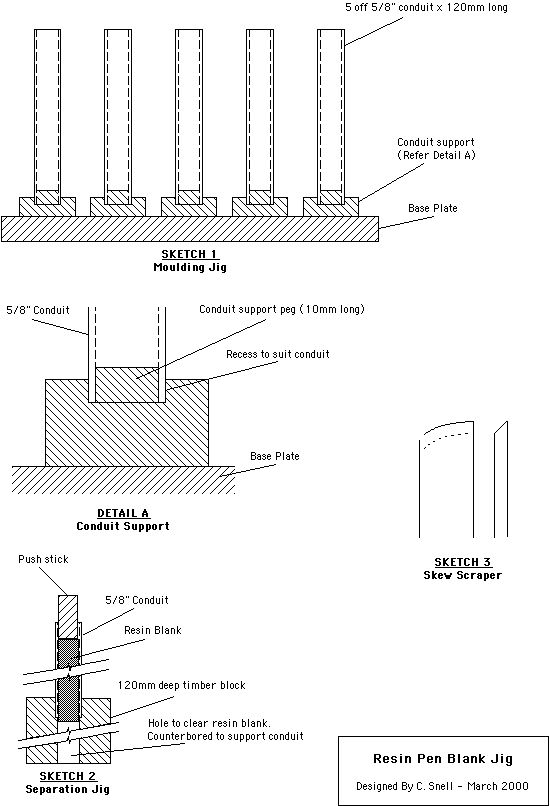
  • 5 pieces 5/8 OD electrical conduit x 120mm long.
  • Timber moulding jig, to support conduits (see sketch 1).
  • Timber separation jig with metal drift (see sketch 2

Preparation

  1. Place small amount of Vaseline onto moulding jig timber pegs and conduit supports.
  2. Locate conduits onto timber pegs.

Mixing Procedure

  1. Place 1 dessertspoon of resin into 3 plastic containers.
  2. Using 3 separate hacksaw blades, place a small amount of each colour into each of the 3 containers and stir thoroughly.
  3. Place 9 dessert spoons of resin into the remaining small plastic container .
  4. With another hacksaw blade, add white colour, slightly more quantity than for the smaller containers and stir thoroughly
  5. Add 4 drops of MEKP Hardener to each of the 3 colour containers,. Stir thoroughly.
  6. Add 36 drops of MEKP Hardener to the white colour container and stir thoroughly.
  7. Pour the contents of the three-colour containers into the white colour container, one at a time, using a circular motion onto the surface of the white resin. DO NOT STIR COLOURS TOGETHER otherwise you will have one solid colour mix and not a colour pattern that you are trying to achieve.
  8. With a clean hacksaw blade, gently pierce or push the colours into the white colour, just a few times, the more you pierce the more you mix the colours into the white base colour.
  9. Gently pour mixture into conduits.
  10. Curing of resin pen blanks may take about 4 hours, depending on temperature. Resin blanks will not stick to the conduits but will shrink away from the sides making it easy to push the blanks out of the conduits.
  11. After the blanks have cured, support conduit in separation jig. Use a steel drift to remove resin blank from conduit, (sketch 2).

Machining

  1. Cut resin blanks to 52mm long.
  2. Set lathe speed to approximately 1200rpm for drilling, turning and finishing operations.
  3. Place Jacob chuck into headstock and place half resin blank into chuck with about 20mm protruding.
  4. Drill through with 6.9mm drill, clearing drill regularly to prevent resin blank from overheating. Note 7.0mm drill will drill oversize hole for the pen brass sleeve.
  5. Repeat above step for other half of resin blank.
  6. Glue brass sleeves into pen blanks, preferably with a 2 pack epoxy glue.
  7. After glue has dried, face ends of resin blanks to suit length of pen brass sleeve.
  8. Place pen blanks onto mandrel.
  9. Rough turning/shaping may be carried out using a one-sided curved skew scraper, (see sketch 3), or by using 80 grit paper.
  10. Turn pen to desired shape with pen clip end turned to 8.1 diameter.

Finishing

  • Use 240 wet and dry paper with water to remove all marks and imperfections.
  • Repeat above step using 400 wet and dry paper and water.
  • Finish polish using metal or car polish.
  • Repeat above step. The pen should now have a high gloss finish, if not repeat step 3.
  • Assemble pen.