Category Archives: woodturning tips

Turning accessories

What is the best accessory you’ve purchased to assist you in you turning efforts? Mine was the Mini-Jumbo Jaws for my One Way chuck.


My “S” toolrest. Second, my chuck. Both make other tools work better.


For me it is the Wolverine Sharpening jig.


The motor or drive controllers that give us variable speed and reverse have made the biggest impact on my turning. Any of the well machined scroll chucks are a close second.


For me DC variable drive without a doubt.


The accessory that has made my life easiest is the John Reed faceplate system. This is one that has a hub and removeable faceplate rings, sold by Craft Supply. I’ve bought two sets so I can have as many as ten segmented bowls under construction at one time.


My best accessory is a vacuum chuck — mine is a Oneway system. I got it to speed up the finishing of bowl bottoms, but once I started using it I discovered its real advantage. 

I now have complete freedom to experiment with the rims of my bowls without having to worry about how I am going to remount them to finish the bottom. This has resulted in the biggest surge in creativity I have had since I have started turning. I considered cobbling up a vacuum chuck system with homemade parts, but I am really happy that I bought the Oneway instead. It works flawlessly.


No doubt about it for me! My fantastic Supernova!


I go along with all that’s been said. But I take chucks and chainsaws for granted now. 

My latest purchase was a Jameison stabilizer handle for my Stewart tools. I’ve done a couple dozen hollow forms over the last two weeks with it and it has made my life easier. It was less fun than the brace handle at first, but now I don’t see how I lived without it. Best money I’ve spent on tools.


I have the Oneway vacuum system and Vicmarc and Oneway button jaws. But the truth is I use jam chucks (using the tailstock) more than the others put together. It’s quicker and I am too lazy to fool around with more equipment sometimes.


I’ve been racking my brain trying to figure out what is the most used accessory. 

It’s between 3 things. 

  • The small jaws for my Nova chuck are used a lot. 
  • My flexible 2″pads for power sanding.
  • My 3/8″ spindle gouge. 

I think I would have to go with the gouge because I use it on almost everything. Even on Bowls there are details around the lip or base that I use the 3/8″ spindle gouge on.


Without a doubt, a good grinding jig (mine is the Australian Heligrind). Without sharp tools, anything else you buy is just another shop ornament.

My most used turning accessory is a home made collar chuck for finishing the bottom of bowls.

I use the nova chuck and the extra jaws are good with the exception of the cole jaws which need new clamps making to be useful. I only use them for finishing the bottom of square bowls.

Filling cracks

What would you recommend for filling cracks in bowls etc discovered towards the end of turning and the job is too nice to throw away and start again.


Use Cyanoacrylate Glue; Super Glue; Hot Stuff; StarBond. these are USA terms, yours might be a bit different.

Actually, it’s all the same chemistry with slight differences from one manufacturer to the other. Some formulations have viscosity differences, some slightly different prices.

Thin cracks, thin glue. Wide cracks, thick glue.

Zap with the commercial catalyst or a solution of baking soda in water. It cures anaerobic, so the zapper is whatever can blanket out the oxygen.


There are many things that do the job. Just a few ideas that come to mind.

  1. Try and pick up some brass, copper or other fine metal filings. Fill the crack with this and saturate with thin CA. Finish turn and sand as usual.
  2. Mix up some epoxy, add a colourent that compliments your turning and finish as usual.
  3. Fill the crack with sanding dust, either same wood or contrasting, and saturate with CA.

Depending on the size of the crack, different approaches can be used:

  1. If the crack is a hairline crack, thin CA glue will penetrate the crack all the way.
  2. For a slightly wider crack, thicker CA glue can be used.
  3. If the crack is a little wide, I often pack the crack with sanding or turning dust from the work piece (hoping for somewhat of a color match). Once packed, you can soak the dust with thin CA glue.
  4. For larger cracks, I use two-part epoxy with tint in it. I have used black and red, so far to good effect. The color makes the crack an interesting feature instead of an ugly defect. I use masking tape to dam the cracks as necessary to prevent filler from running out.

If the crack penetrates all the way through the wood, you can dam the back side with masking tape and peel or turn away after it is dry. These techniques may require a few repeated applications to fully fill the void. Also, epoxy tends to get air bubbles which take several minutes to work to the surface and require refilling when dry.

Dust Collector Shavings Extractor


By Keith Jeeves
Sydney Woodturners Guild


A dust collector is essential in a woodturners workshop to keep fine sanding dust under some sort of control. The dust collector can also be used as a vacuum cleaner for removing shavings from the workshop. A simple cloth bag type is quite adequate for sanding but has problems when used as a shop vacuum cleaner.

The inlet to the dust collector is fitted with a guard to prevent large objects being drawn into the fan and causing damage but when sucking up shavings, the guard rapidly becomes blocked requiring frequent removal of the hose and clearing of the inlet duct. Wet shavings are much more prone to blocking the duct than dry shavings but both cause problems.

For a number of reasons, vacuum cleaning is preferable to brush cleaning for cleaning up the shop;

  • Chips tend to get amongst stored wood and equipment where a brush cannot easily reach
  • Tools and pieces of equipment get dropped in shavings and are sometimes difficult to spot when sweeping and they get thrown out. A vacuum cleaner will pick up the shavings and leave more solid objects behind where they can easily be recovered.

An industrial dust collector is often fitted with a cyclone which will separate the heavier particles from fine dust but is not a practical proposition for a home workshop. If a simple shavings extractor could be devised which prevented shavings from entering the dust collector inlet duct, the device would be much more useful. It would not matter if some dust remained with the shavings as long as the shavings were kept out of the dust collector inlet.

After a little experimenting, a very effective separator was built comprising a plastic garbage bin with 2 PVC plumbing type pipe flanges fitted into the lid. One flange was piped to the dust collector and the shop hose was fitted to the other. The dust collector draws a vacuum in the garbage bin which, in turn, draws air from the shop hose. Any heavy material entering the bin immediately drops to the bottom but fine dust remains airborne where is is drawn out by the dust collector pipe and ends up in the collection bag in the normal way. Almost no shavings are transferred from the shop hose to the dust collector hose unless the bin is allowed to fill towards the top. As a bonus, it is much easier and less messy to empty the garbage bin than the dust collector collection bag.

The general arrangement is as follows – the sketch should be self explanatory;

Points to be aware of when building the separator are

  • A garbage bin is not intended to be airtight so a foam rubber strip needs to be fitted between the bin and its lid to prevent entry of air. The seal does not have to be perfect but should be good. The lid clamps will tend to distort the lid when tightened down against the foam strip but can be bent to give less clamping pressure. By putting foam strip around the outside of the bin, between the side of the rim and the lid, a good push fit can be achieved which will not require use of the lid clamps at all.
  • The pipe flanges can be fixed with either silicon sealant or hot melt glue. Rough up the surface a bit before applying the adhesive.
  • The hoses will probably not be a good fit into plumbing type pipe flanges and purpose made flanges which will provide a snug fit are quite expensive. The fit can be improved by wrapping PVC insulating tape around the end of the hose or by permanently fixing the hose into the flange with sealant or hot melt glue.
  • The bin should not be allowed to become more than about three quarters full. If overfilled, the dust is held by the shavings and does not transfer to the dust collector hose and shavings will be picked up by the dust collector hose where they will find their way into the dust collector inlet.
  • Although some loss of air flow at the end of the shop hose occurs, the loss is surprisingly low. If it is important to have maximum available air flow at the sanding area, a separate length of hose connected directly to the dust collector can be used during sanding

Turning accessories

What is the best accessory you’ve purchased to assist you in you turning efforts? Mine was the Mini-Jumbo Jaws for my One Way chuck.


My “S” toolrest. Second, my chuck. Both make other tools work better.


For me it is the Wolverine Sharpening jig.


The motor or drive controllers that give us variable speed and reverse have made the biggest impact on my turning. Any of the well machined scroll chucks are a close second.


For me DC variable drive without a doubt.


The accessory that has made my life easiest is the John Reed faceplate system. This is one that has a hub and removeable faceplate rings, sold by Craft Supply. I’ve bought two sets so I can have as many as ten segmented bowls under construction at one time.


My best accessory is a vacuum chuck — mine is a Oneway system. I got it to speed up the finishing of bowl bottoms, but once I started using it I discovered its real advantage. 

I now have complete freedom to experiment with the rims of my bowls without having to worry about how I am going to remount them to finish the bottom. This has resulted in the biggest surge in creativity I have had since I have started turning. I considered cobbling up a vacuum chuck system with homemade parts, but I am really happy that I bought the Oneway instead. It works flawlessly.


No doubt about it for me! My fantastic Supernova!


I go along with all that’s been said. But I take chucks and chainsaws for granted now. 

My latest purchase was a Jameison stabilizer handle for my Stewart tools. I’ve done a couple dozen hollow forms over the last two weeks with it and it has made my life easier. It was less fun than the brace handle at first, but now I don’t see how I lived without it. Best money I’ve spent on tools.


I have the Oneway vacuum system and Vicmarc and Oneway button jaws. But the truth is I use jam chucks (using the tailstock) more than the others put together. It’s quicker and I am too lazy to fool around with more equipment sometimes.


I’ve been racking my brain trying to figure out what is the most used accessory. 

It’s between 3 things. 

  • The small jaws for my Nova chuck are used a lot. 
  • My flexible 2″pads for power sanding.
  • My 3/8″ spindle gouge. 

I think I would have to go with the gouge because I use it on almost everything. Even on Bowls there are details around the lip or base that I use the 3/8″ spindle gouge on.


Without a doubt, a good grinding jig (mine is the Australian Heligrind). Without sharp tools, anything else you buy is just another shop ornament.

My most used turning accessory is a home made collar chuck for finishing the bottom of bowls.

I use the nova chuck and the extra jaws are good with the exception of the cole jaws which need new clamps making to be useful. I only use them for finishing the bottom of square bowls.

Making Pens With Polyester Resin


By Clarrie Snell
Sydney Woodturners Guild


The pens may initially take a while to make, however the finished article is extremely durable with brilliant colours that are striking and pleasing to the eye.

Mixing Equipment

  1. 4 flexible plastic containers (bottom half of small round drink containers or drink cups).
  2. 6 Stirrers (old hacksaw blades, or wooden sticks).
  3. Eye dropper.
  4. Dessert spoon or measuring cup.

Safety

  1. Wear eye protection during the mixing procedure. The Resin Hardener, MEKP, is a dangerous substance to handle. Safety goggles should be worn during handling, as loss of eyesight is possible if MEKP comes in contact with the eyes. 

    Read safety instructions before using this substance.
  2. Wear face masks with filters to suit chemicals during the mixing procedure, machining and finishing.
  3. Wear disposable gloves during mixing procedure.

Chemicals

  1. Acetone for cleaning purposes.
  2. Surf Board Resin (Finishing Resin GC3).
  3. Resin Hardener (MEKP)
  4. Resin colours to suit your taste.
  5. Vaseline (petroleum Jelly).

Mould and release equipment

  1. 5 pieces 5/8 OD electrical conduit x 120mm long.
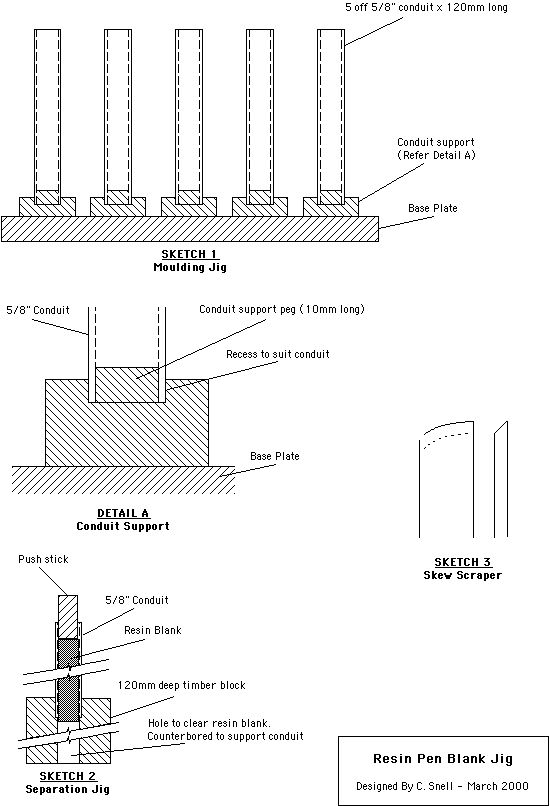
  2. Timber moulding jig, to support conduits (see sketch 1).
  3. Timber separation jig with metal drift (see sketch 2).

Preparation

  1. Place small amount of Vaseline onto moulding jig timber pegs and conduit supports. 
  2. Locate conduits onto timber pegs.

Mixing Procedure

  1. Place 1 dessertspoon of resin into 3 plastic containers.
  2. Using 3 separate hacksaw blades, place a small amount of each colour into each of the 3 containers and stir thoroughly.
  3. Place 9 dessert spoons of resin into the remaining small plastic container .
  4. With another hacksaw blade, add white colour, slightly more quantity than for the smaller containers and stir thoroughly
  5. Add 4 drops of MEKP Hardener to each of the 3 colour containers,. Stir thoroughly.
  6. Add 36 drops of MEKP Hardener to the white colour container and stir thoroughly.
  7. Pour the contents of the three-colour containers into the white colour container, one at a time, using a circular motion onto the surface of the white resin. DO NOT STIR COLOURS TOGETHER otherwise you will have one solid colour mix and not a colour pattern that you are trying to achieve.
  8. With a clean hacksaw blade, gently pierce or push the colours into the white colour, just a few times, the more you pierce the more you mix the colours into the white base colour.
  9. Gently pour mixture into conduits.
  10. Curing of resin pen blanks may take about 4 hours, depending on temperature. Resin blanks will not stick to the conduits but will shrink away from the sides making it easy to push the blanks out of the conduits.
  11. After the blanks have cured, support conduit in separation jig. Use a steel drift to remove resin blank from conduit, (sketch 2).

Machining

  1. Cut resin blanks to 52mm long.
  2. Set lathe speed to approximately 1200rpm for drilling, turning and finishing operations.
  3. Place Jacob chuck into headstock and place half resin blank into chuck with about 20mm protruding.
  4. Drill through with 6.9mm drill, clearing drill regularly to prevent resin blank from overheating. Note 7.0mm drill will drill oversize hole for the pen brass sleeve.
  5. Repeat above step for other half of resin blank.
  6. Glue brass sleeves into pen blanks, preferably with a 2 pack epoxy glue.
  7. After glue has dried, face ends of resin blanks to suit length of pen brass sleeve.
  8. Place pen blanks onto mandrel.
  9. Rough turning/shaping may be carried out using a one-sided curved skew scraper, (see sketch 3), or by using 80 grit paper.
  10. Turn pen to desired shape with pen clip end turned to 8.1 diameter.

Finishing

  1. Use 240 wet and dry paper with water to remove all marks and imperfections.
  2. Repeat above step using 400 wet and dry paper and water.
  3. Finish polish using metal or car polish.
  4. Repeat above step. The pen should now have a high gloss finish, if not repeat step 3.
  5. Assemble pen.

Sanding details

Collated from newsgroup postings.

Sanding for me is still one of my biggest hurdles in producing quality work (quality at least in the sense it’s the best I am capable of).

An area where I pretty consistently end up with less than perfect sanding is on the outside of bowls where two surfaces meet. Like next to a bead or at the foot. I can’t seem to get right next to the raised surface as well as I need to.

I use a combination of hand and power sanding with the usual assortment of tools and papers and typically sand through about 600.

Anyone have any advice on a way to hold/move sandpaper to get these transitions crisp and perfect? 


Transitions do need to be crisp. 

  • Freshly sharpened tools are invaluable when you attempt delicate clarifying cuts into or at detail transitions.
  • Light, delicate, accurate shear cuts, or shear scrapes into these areas is the ideal. On bowls for instance, I’d nip in with a light, precise shear-cut wherever possible. If you do it right, you virtually eliminate ANY real sanding needs in these restricted areas.
  • If you do need to sand in these areas, use scissors to cut strips of sandpaper cleanly. Pull the crisp edge of the sandpaper into the area in question, and slide the sharp edge of the sandpaper back and forth as needed.

    Sometimes, depending on the contour, I might fold sandpaper in half so that I’ve got a double sided “knife” of sandpaper I can slide into the appropriate place.

On a bowl foot, my last little cuts where shear-cuts oriented in a direction parallel to the first rim of the foot driving INTO the bottom of the bowl. That’s the teensy little vertical off the bottom of the bowl that transitions into a little o-gee. My spindle gouge (freshly sharpened) was oriented out in space so the nose/toe was pointed straight into the bottom of the bowl. I eased forward taking a light teensy cut nipping that first little flat true, then STOPPED the cut when the nose of the spindle gouge touched where I thought the bottom of the curve should meet that little vertical. I then did a teensy little shear-scrape out away from that vertical to nibble the curved transition of the bottom of the bowl true to that.

I did follow up with 220, 320, 400 as described previously, but the surface was good, so it was quick.


If you’re not using a high quality sand paper, try changing brands. You may also have better luck sanding with the lathe off. I have a nice magnifying lense to look through, which really helps with the detail work.


Do it (scraping) with a skew. Put it on its side, and put the point into the detail corner, first from one direction, then the other. No need to sand in here. The skew, used this way, will handle it well enough so it’s ready to finish. Just use a light touch, and experiment.


I often leave a foot on a bowl, and I’ve had good results with a diamond-point scraper. I made mine from a flat parting tool that I wasn’t using – just ground the end to a point and with the usual scraper bevel on each side of the point. So I use one side on the foot, carefully take the point right into the line of transition, then come out of it with the other side scraping the bowl wall. Takes a little practice but it works great. Like all scrapers, if it’s REALLY REALLY sharp you won’t have to do much sanding.


I agree with everyone who suggests using a really sharp tool to form the internal corner you’re talking about. I always make a very fine cut to form the corner. It gives any piece a more professional look and also marks the edge of your sanding. However, you nevertheless often have to sand. The suggestion about cutting a crisp edge and using that is definitely the way to go. I would just add two points. 

  • Hold the sandpaper in a curve which approximates the radius of your surface, so that you don’t cut away either of the adjoining faces. 
  • Sand lightly.
    I’ve found that most people get into trouble by sanding with too much pressure. Sanding lightly is faster because you can get away with using coarser paper, and you don’t risk ruining your shape. If you’re losing grit or clogging up the paper with burnt dust, you’re pressing much too hard.


Back to the Articles page

Making pens with polyester resin

Making Pens With Polyester Resin

By Clarrie Snell

The pens may initially take a while to make, however the finished article is extremely durable with brilliant colours that are striking and pleasing to the eye.

Mixing Equipment

  • 4 flexible plastic containers (bottom half of small round drink containers or drink cups).
  • 6 Stirrers (old hacksaw blades, or wooden sticks).
  • Eye dropper.
  • Dessert spoon or measuring cup.

Safety

  • Wear eye protection during the mixing procedure. The Resin Hardener, MEKP, is a dangerous substance to handle. Safety goggles should be worn during handling, as loss of eyesight is possible if MEKP comes in contact with the eyes.
  • Read safety instructions before using this substance.
  • Wear face masks with filters to suit chemicals during the mixing procedure, machining and finishing.
  • Wear disposable gloves during mixing procedure.

Chemicals

  • Acetone for cleaning purposes.
  • Surf Board Resin (Finishing Resin GC3).
  • Resin Hardener (MEKP)
  • Resin colours to suit your taste.
  • Vaseline (petroleum Jelly).

Mould and release equipment

  • 5 pieces 5/8 OD electrical conduit x 120mm long.
  • Timber moulding jig, to support conduits (see sketch 1).
  • Timber separation jig with metal drift (see sketch 2

Preparation

  1. Place small amount of Vaseline onto moulding jig timber pegs and conduit supports.
  2. Locate conduits onto timber pegs.

Mixing Procedure

  1. Place 1 dessertspoon of resin into 3 plastic containers.
  2. Using 3 separate hacksaw blades, place a small amount of each colour into each of the 3 containers and stir thoroughly.
  3. Place 9 dessert spoons of resin into the remaining small plastic container .
  4. With another hacksaw blade, add white colour, slightly more quantity than for the smaller containers and stir thoroughly
  5. Add 4 drops of MEKP Hardener to each of the 3 colour containers,. Stir thoroughly.
  6. Add 36 drops of MEKP Hardener to the white colour container and stir thoroughly.
  7. Pour the contents of the three-colour containers into the white colour container, one at a time, using a circular motion onto the surface of the white resin. DO NOT STIR COLOURS TOGETHER otherwise you will have one solid colour mix and not a colour pattern that you are trying to achieve.
  8. With a clean hacksaw blade, gently pierce or push the colours into the white colour, just a few times, the more you pierce the more you mix the colours into the white base colour.
  9. Gently pour mixture into conduits.
  10. Curing of resin pen blanks may take about 4 hours, depending on temperature. Resin blanks will not stick to the conduits but will shrink away from the sides making it easy to push the blanks out of the conduits.
  11. After the blanks have cured, support conduit in separation jig. Use a steel drift to remove resin blank from conduit, (sketch 2).

Machining

  1. Cut resin blanks to 52mm long.
  2. Set lathe speed to approximately 1200rpm for drilling, turning and finishing operations.
  3. Place Jacob chuck into headstock and place half resin blank into chuck with about 20mm protruding.
  4. Drill through with 6.9mm drill, clearing drill regularly to prevent resin blank from overheating. Note 7.0mm drill will drill oversize hole for the pen brass sleeve.
  5. Repeat above step for other half of resin blank.
  6. Glue brass sleeves into pen blanks, preferably with a 2 pack epoxy glue.
  7. After glue has dried, face ends of resin blanks to suit length of pen brass sleeve.
  8. Place pen blanks onto mandrel.
  9. Rough turning/shaping may be carried out using a one-sided curved skew scraper, (see sketch 3), or by using 80 grit paper.
  10. Turn pen to desired shape with pen clip end turned to 8.1 diameter.

Finishing

  • Use 240 wet and dry paper with water to remove all marks and imperfections.
  • Repeat above step using 400 wet and dry paper and water.
  • Finish polish using metal or car polish.
  • Repeat above step. The pen should now have a high gloss finish, if not repeat step 3.
  • Assemble pen.